Trenching Safety: A Field Guide for Construction Supervisors
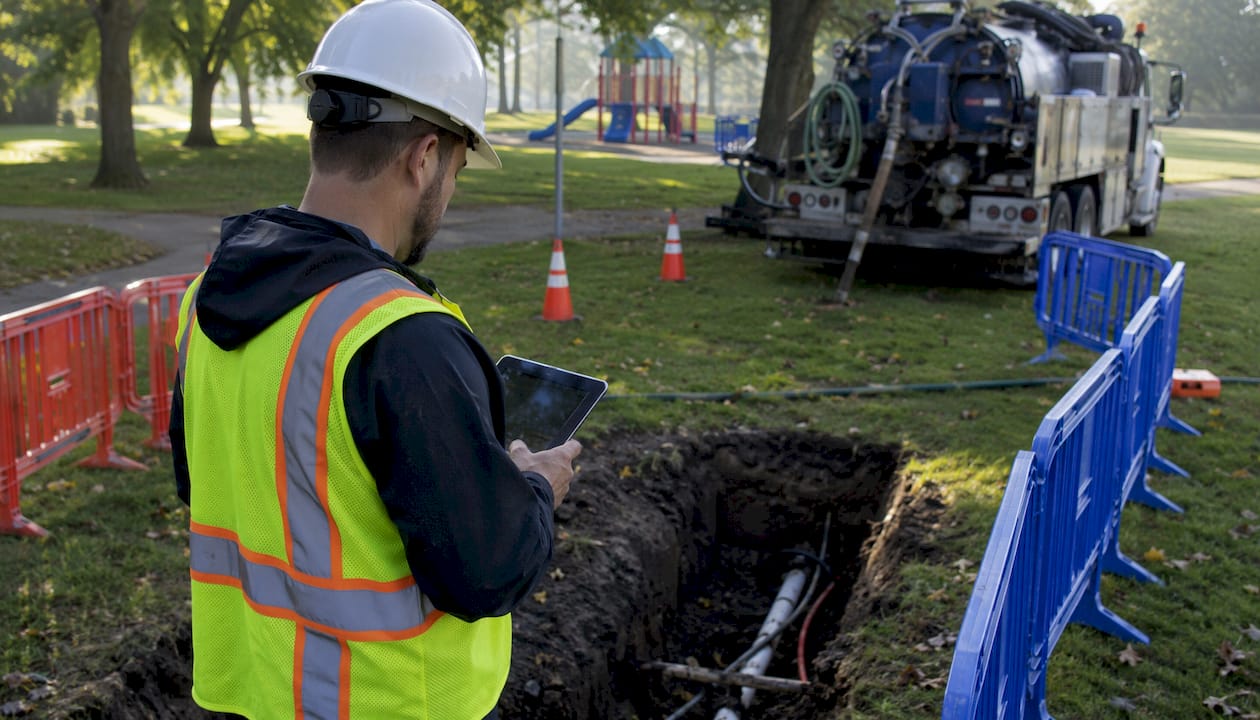
Ensure trenching safety on your job sites with our essential guide. Learn necessary protective measures and compliance requirements to keep workers safe.
.webp)
Ensure trenching safety on your job sites with our essential guide. Learn necessary protective measures and compliance requirements to keep workers safe.
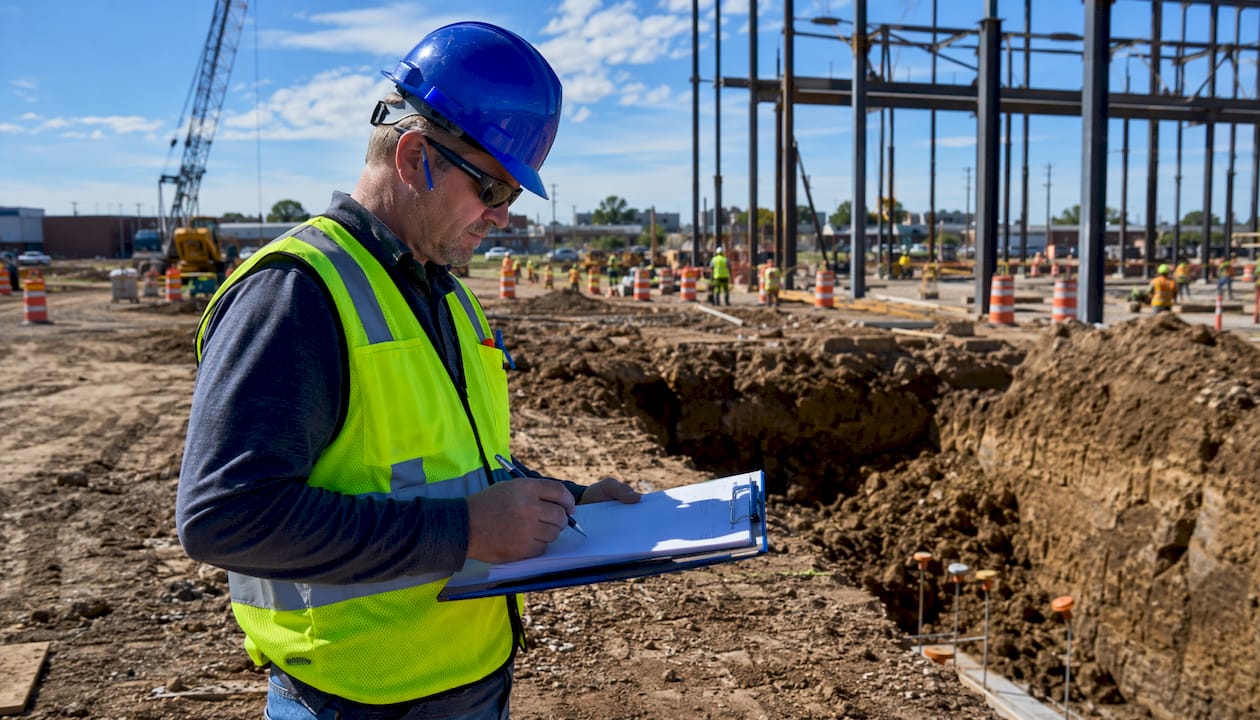
For every trench 5 feet or deeper, a protective system must be in place before any worker enters — no exceptions under 29 CFR 1926 Subpart P. If the excavation is entirely in stable rock, document that determination. For trenches reaching 20 feet or deeper, a registered professional engineer must design or approve the protective system. These are the non-negotiables that govern every excavation job in the United States.
Before crews enter, run through this checklist:
NIOSH data and Bureau of Labor Statistics records confirm that trench collapses kill workers every year — and the majority of those incidents trace back to skipped steps on this exact list.
Cave-ins are the leading fatal hazard in excavation work, and the physics are unforgiving. One cubic yard of soil can weigh as much as a car — a fact that makes any unprotected trench a life-threatening environment. According to Bureau of Labor Statistics data, collapse and engulfment in open trenches or excavations accounted for 18 fatal occupational injuries in 2024 across private industry sectors.
Beyond cave-ins, supervisors must account for a wider set of hazards on every job:
The typical causal chain in a fatal collapse is predictable: soil classified too optimistically, no protective system installed, recent rain ignored, and no competent person on site. Each of those failures is preventable. Many incidents trace directly to inadequate pre-job planning and failure to account for local factors like adjacent traffic vibration or recent precipitation — conditions that were visible before the first shovel broke ground.
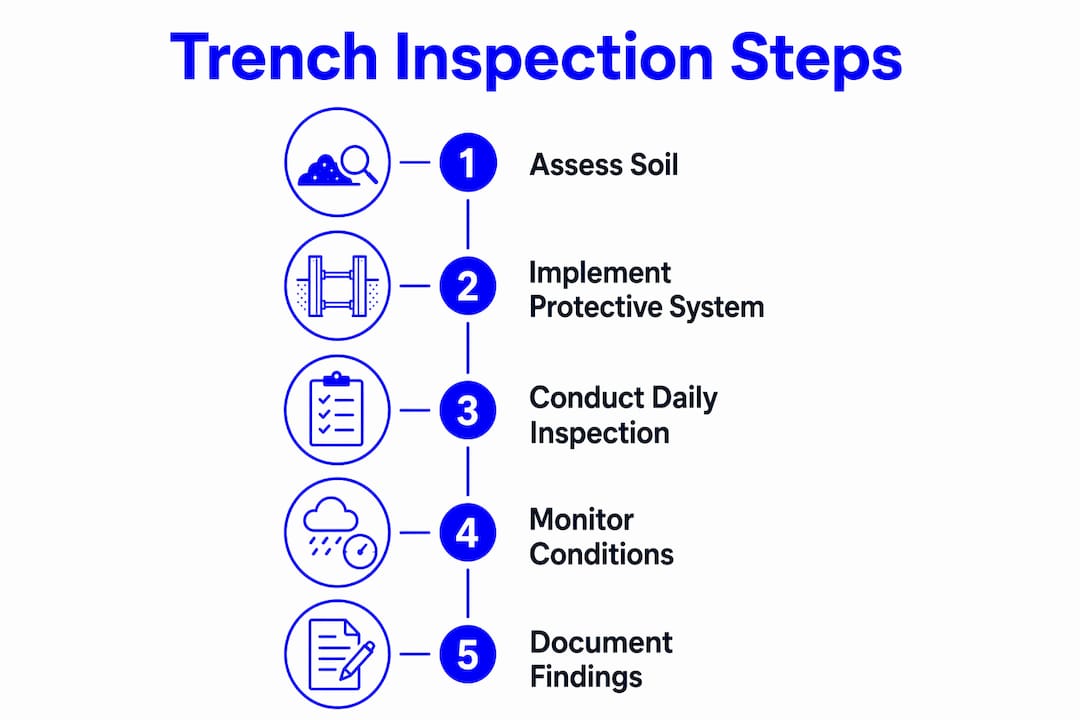
29 CFR 1926 Subpart P sets the federal floor for all excavation work in the United States. The standard applies to every open excavation in the earth’s surface, including trenches. Supervisors need to know the specific thresholds, not just the general concept.
Core thresholds and requirements:
The competent person is not a title — it is a legal designation with real authority. Under Subpart P, the competent person must be appointed by the employer, must have the training and experience to identify hazardous conditions, and must have the authority to stop work and remove employees immediately. Daily inspections are mandatory: before each shift, after any rainstorm or water intrusion, after vibrations or blasting, and whenever conditions change. If the competent person finds an unsafe condition, workers must leave the hazardous area until corrections are made. No production schedule overrides that authority.
The competent person’s inspection duties cover the trench itself, adjacent areas, and all protective systems. That scope matters — a wall that looks stable at the start of a shift can deteriorate within hours when groundwater rises or heavy equipment operates nearby.

OSHA’s 2018 National Emphasis Program on trenching put excavation violations under sustained federal scrutiny, and the numbers have moved accordingly. Trenching-related citations and average penalties increased markedly from 2011 through 2023, shifting non-compliance from a manageable line item into a significant project-level financial risk. The most frequently cited Subpart P provisions are protections in excavations (1926.652), inspections (1926.651), and access/egress requirements — the same items on the pre-entry checklist above.
The provisions cited most often are also the ones easiest to document in advance. A written work plan that names the competent person, identifies the protective system, records the soil classification method, and schedules inspection triggers gives supervisors a paper trail that demonstrates good-faith compliance. Inadequate pre-job planning is the common thread in both fatal incidents and costly citations — which means the same planning effort that prevents injuries also reduces enforcement exposure.
Pro Tip: Keep a dated, signed inspection log for every shift. In an OSHA investigation, a documented decision is far easier to defend than a verbal one — and a log showing the competent person identified and corrected a hazard demonstrates exactly the proactive compliance OSHA’s enforcement framework rewards.
Soil classification drives every protective-system decision. Get it wrong and the system you install may provide no real protection. The four soil categories under Subpart P are:
Protective system options:
Decision flow — use this sequence on every job:
Pro Tip: A trench box is shielding, not shoring. Workers inside a properly placed trench box are protected from burial if the walls collapse around it — but the soil is still moving. If your competent person sees tension cracks or wall movement outside the box, that is a stop-work condition regardless of what shielding is in place.
Access, egress, spoil management, utility locating, and atmospheric testing are all pre-entry requirements, not afterthoughts. Each one addresses a distinct failure mode.
Access and egress:
Spoil and equipment placement:
Traffic control:
Utility locating:
Atmospheric testing:
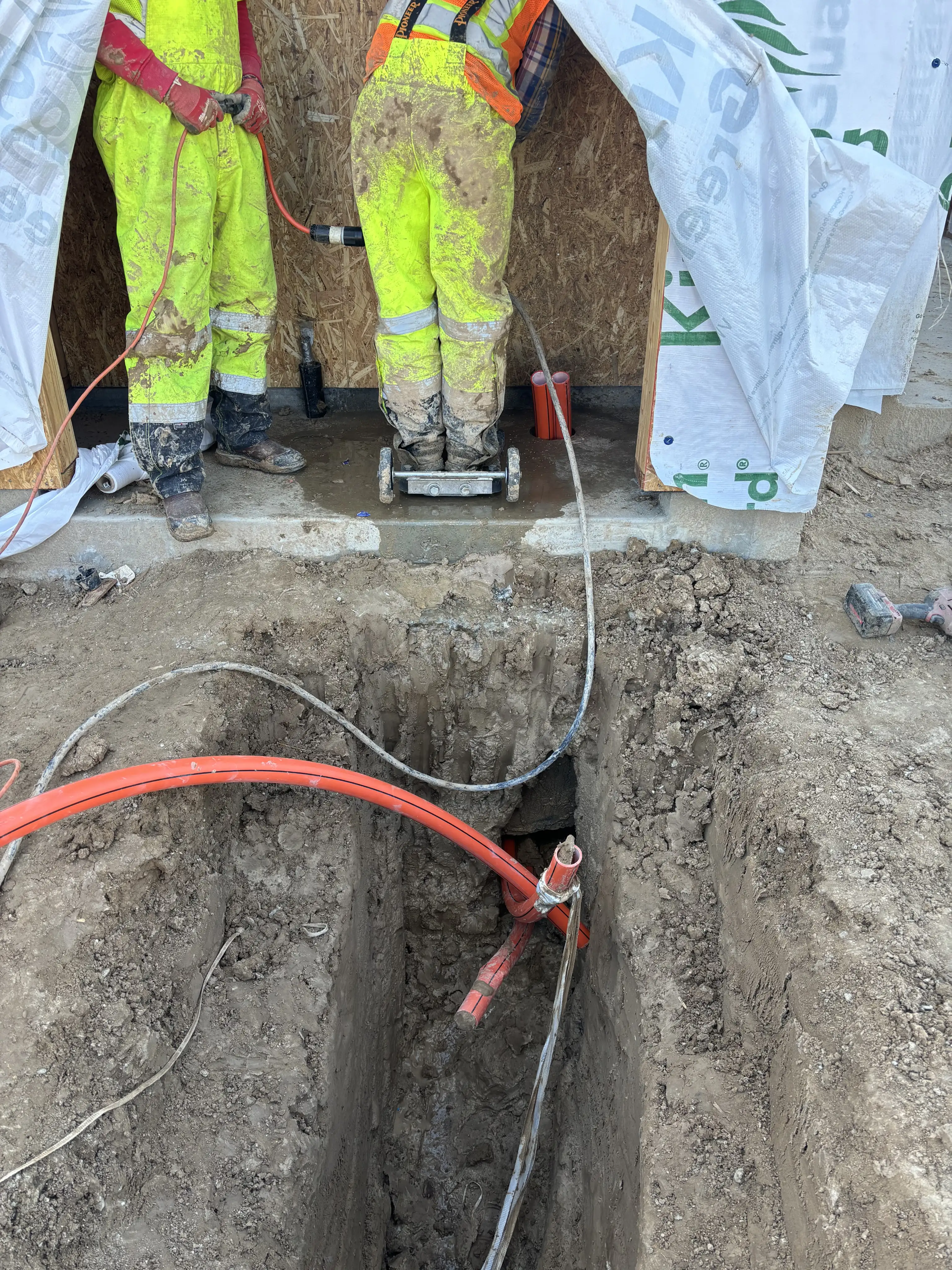
Pro Tip: When 811 marks are present but utility depth or exact position is uncertain, vacuum excavation exposes the line safely before mechanical digging begins. This single step eliminates the most common cause of utility strikes on Colorado job sites.
Inspection cadence under Subpart P is specific. The competent person must inspect:
Items the competent person must check on every inspection:
Sample inspection log format:
Use this table as a daily field record. A completed log with corrective actions documented is your primary defense in an OSHA inspection and your clearest evidence of a functioning competent-person program.
Stop-work triggers — evacuate immediately if any of these appear:
Pro Tip: Date and sign every inspection entry at the time of inspection, not at the end of the day. Backdated logs are a liability in enforcement proceedings and undermine the credibility of an otherwise solid safety program.
Rescue planning is a pre-task requirement, not a post-incident response. OSHA requires that emergency rescue equipment be readily available whenever hazardous atmospheric conditions exist or may develop. The rescue plan should be written, posted, and reviewed with the crew before work begins.
Rescue plan essentials:
Equipment to stage at the trench:
Drill frequency should match job duration and crew turnover. For longer projects, a tabletop drill at the start of each new crew rotation takes 15 minutes and covers the scenarios most likely to occur on that specific site.
Pro Tip: Run a tabletop drill on day one of every new job — not a full physical exercise, just a verbal walkthrough: who calls 911, who controls the perimeter, who operates the pump, who manages the lifeline. Workers who have rehearsed the steps respond faster and more effectively when conditions deteriorate.
A competent-person program has two components: documented initial training and a system for ongoing verification. Neither is optional under Subpart P, and both are reviewed during OSHA inspections.
Core training topics for the competent person:
Core training topics for site crew:
Training cadence and documentation:
Work-plan templates from state L&I guidance provide a practical format for documenting hazards, protective systems, inspection schedules, and competent-person assignment. Adapt one for your operation and keep it in the job file.
Documentation checklist:
Pro Tip: Store training records and inspection logs digitally — a photo of the signed daily log uploaded to a shared folder takes seconds and survives the job site conditions that destroy paper records.
Trenching safety compliance requires a competent person on-site, a documented protective system for every trench 5 feet or deeper, confirmed utility locates, and a signed inspection log before any worker enters the excavation.
| Point | Details |
|---|---|
| Protective system threshold | Required for all trenches ≥5 ft deep; PE-designed system required at ≥20 ft. |
| Competent person authority | Must inspect daily, after rain or vibrations, and has legal authority to stop work immediately. |
| Access and egress | Ladders or ramps required in trenches ≥4 ft, within 25 ft of lateral travel. |
| Spoil and equipment setback | Minimum 2 ft from trench edge; increase separation in saturated or unstable soils. |
| Rocky Mountain Underground | Hydrovac potholing and SUE services reduce utility-strike and cave-in risk before mechanical trenching begins. |
The gap between written safety programs and field reality usually shows up at one moment: when a foreman is behind schedule and the competent person identifies a condition that requires a stop. How that moment is handled defines the safety culture of the entire project.
A competent person who stops work to address wall movement or water ingress is not slowing the job — they are preventing the kind of incident that shuts a project down for weeks, triggers an OSHA investigation, and results in citations that now carry substantially higher average penalties than they did a decade ago. The authority to stop work is not a suggestion in Subpart P. It is a legal line of defense for the employer, the crew, and the competent person themselves.
For toolbox talks, keep the brief to five minutes and three points: what the protective system is today, where the egress points are, and what to do if conditions change. Rotate the third point weekly — tension cracks one week, water accumulation the next, atmospheric testing the week after. Repetition builds the recognition speed that matters when something starts to go wrong.
When schedule pressure is real, document the decision. If a supervisor chooses to proceed with modified controls, write down what was observed, what was decided, and why. A documented decision that shows the competent person evaluated the hazard and implemented a control is defensible. An undocumented one is not.
The highest-risk moment in any excavation is the period between “utilities marked” and “exact location confirmed.” That gap is where utility strikes happen, and where a trench protective system can be undermined by an unmarked line no one knew was there.
Rocky Mountain Underground addresses that gap directly. RMU’s hydrovac potholing and subsurface utility engineering services expose buried utilities without mechanical contact, giving your competent person accurate depth and position data before trenching begins. The workflow is straightforward: pre-task consultation to identify risk zones, hydrovac potholing to confirm utility locations, and SUE documentation that supports your protective-system decisions and work plan. For Colorado contractors and municipalities working in congested utility corridors, that sequence reduces both utility-strike exposure and the soil disturbance that can destabilize adjacent trench walls.
Contact Rocky Mountain Underground to request a quote or discuss your project’s excavation requirements before work begins.
Supervisors and safety leads should keep these authoritative sources accessible throughout any excavation project:
This article is general safety and compliance information, not legal or engineering advice. Verify current OSHA standards and consult a qualified professional for site-specific determinations.
A protective system is required for any trench 5 feet or deeper, unless the excavation is entirely in stable rock or a competent person documents no cave-in potential for trenches under 5 feet. Trenches 20 feet or deeper require a system designed by a registered professional engineer.
The competent person must inspect before each shift, after any rainstorm or water intrusion, after vibrations or blasting, and after any event that could change trench conditions — with authority to stop work and remove workers if hazards are found.
Shoring actively supports trench walls to prevent soil movement; shielding (such as a trench box) protects workers inside the structure if a collapse occurs but does not stop the soil from moving around it.
Calling 811 is required before any excavation begins in the United States. Utility owners must be contacted and given the required response time to mark underground installations before mechanical digging starts.
Hydrovac potholing uses pressurized water and vacuum suction to expose buried utilities without mechanical contact, confirming exact depth and position before trenching begins. Rocky Mountain Underground provides this service across Colorado to eliminate utility-strike risk during excavation projects.
For every trench 5 feet or deeper, a protective system must be in place before any worker enters — no exceptions under 29 CFR 1926 Subpart P. If the excavation is entirely in stable rock, document that determination. For trenches reaching 20 feet or deeper, a registered professional engineer must design or approve the protective system. These are the non-negotiables that govern every excavation job in the United States.
Before crews enter, run through this checklist:
NIOSH data and Bureau of Labor Statistics records confirm that trench collapses kill workers every year — and the majority of those incidents trace back to skipped steps on this exact list.
Cave-ins are the leading fatal hazard in excavation work, and the physics are unforgiving. One cubic yard of soil can weigh as much as a car — a fact that makes any unprotected trench a life-threatening environment. According to Bureau of Labor Statistics data, collapse and engulfment in open trenches or excavations accounted for 18 fatal occupational injuries in 2024 across private industry sectors.
Beyond cave-ins, supervisors must account for a wider set of hazards on every job:
The typical causal chain in a fatal collapse is predictable: soil classified too optimistically, no protective system installed, recent rain ignored, and no competent person on site. Each of those failures is preventable. Many incidents trace directly to inadequate pre-job planning and failure to account for local factors like adjacent traffic vibration or recent precipitation — conditions that were visible before the first shovel broke ground.
29 CFR 1926 Subpart P sets the federal floor for all excavation work in the United States. The standard applies to every open excavation in the earth’s surface, including trenches. Supervisors need to know the specific thresholds, not just the general concept.
Core thresholds and requirements:
The competent person is not a title — it is a legal designation with real authority. Under Subpart P, the competent person must be appointed by the employer, must have the training and experience to identify hazardous conditions, and must have the authority to stop work and remove employees immediately. Daily inspections are mandatory: before each shift, after any rainstorm or water intrusion, after vibrations or blasting, and whenever conditions change. If the competent person finds an unsafe condition, workers must leave the hazardous area until corrections are made. No production schedule overrides that authority.
The competent person’s inspection duties cover the trench itself, adjacent areas, and all protective systems. That scope matters — a wall that looks stable at the start of a shift can deteriorate within hours when groundwater rises or heavy equipment operates nearby.
OSHA’s 2018 National Emphasis Program on trenching put excavation violations under sustained federal scrutiny, and the numbers have moved accordingly. Trenching-related citations and average penalties increased markedly from 2011 through 2023, shifting non-compliance from a manageable line item into a significant project-level financial risk. The most frequently cited Subpart P provisions are protections in excavations (1926.652), inspections (1926.651), and access/egress requirements — the same items on the pre-entry checklist above.
The provisions cited most often are also the ones easiest to document in advance. A written work plan that names the competent person, identifies the protective system, records the soil classification method, and schedules inspection triggers gives supervisors a paper trail that demonstrates good-faith compliance. Inadequate pre-job planning is the common thread in both fatal incidents and costly citations — which means the same planning effort that prevents injuries also reduces enforcement exposure.
Pro Tip: Keep a dated, signed inspection log for every shift. In an OSHA investigation, a documented decision is far easier to defend than a verbal one — and a log showing the competent person identified and corrected a hazard demonstrates exactly the proactive compliance OSHA’s enforcement framework rewards.
Soil classification drives every protective-system decision. Get it wrong and the system you install may provide no real protection. The four soil categories under Subpart P are:
Protective system options:
Decision flow — use this sequence on every job:
Pro Tip: A trench box is shielding, not shoring. Workers inside a properly placed trench box are protected from burial if the walls collapse around it — but the soil is still moving. If your competent person sees tension cracks or wall movement outside the box, that is a stop-work condition regardless of what shielding is in place.
Access, egress, spoil management, utility locating, and atmospheric testing are all pre-entry requirements, not afterthoughts. Each one addresses a distinct failure mode.
Access and egress:
Spoil and equipment placement:
Traffic control:
Utility locating:
Atmospheric testing:
Pro Tip: When 811 marks are present but utility depth or exact position is uncertain, vacuum excavation exposes the line safely before mechanical digging begins. This single step eliminates the most common cause of utility strikes on Colorado job sites.
Inspection cadence under Subpart P is specific. The competent person must inspect:
Items the competent person must check on every inspection:
Sample inspection log format:
Use this table as a daily field record. A completed log with corrective actions documented is your primary defense in an OSHA inspection and your clearest evidence of a functioning competent-person program.
Stop-work triggers — evacuate immediately if any of these appear:
Pro Tip: Date and sign every inspection entry at the time of inspection, not at the end of the day. Backdated logs are a liability in enforcement proceedings and undermine the credibility of an otherwise solid safety program.
Rescue planning is a pre-task requirement, not a post-incident response. OSHA requires that emergency rescue equipment be readily available whenever hazardous atmospheric conditions exist or may develop. The rescue plan should be written, posted, and reviewed with the crew before work begins.
Rescue plan essentials:
Equipment to stage at the trench:
Drill frequency should match job duration and crew turnover. For longer projects, a tabletop drill at the start of each new crew rotation takes 15 minutes and covers the scenarios most likely to occur on that specific site.
Pro Tip: Run a tabletop drill on day one of every new job — not a full physical exercise, just a verbal walkthrough: who calls 911, who controls the perimeter, who operates the pump, who manages the lifeline. Workers who have rehearsed the steps respond faster and more effectively when conditions deteriorate.
A competent-person program has two components: documented initial training and a system for ongoing verification. Neither is optional under Subpart P, and both are reviewed during OSHA inspections.
Core training topics for the competent person:
Core training topics for site crew:
Training cadence and documentation:
Work-plan templates from state L&I guidance provide a practical format for documenting hazards, protective systems, inspection schedules, and competent-person assignment. Adapt one for your operation and keep it in the job file.
Documentation checklist:
Pro Tip: Store training records and inspection logs digitally — a photo of the signed daily log uploaded to a shared folder takes seconds and survives the job site conditions that destroy paper records.
Trenching safety compliance requires a competent person on-site, a documented protective system for every trench 5 feet or deeper, confirmed utility locates, and a signed inspection log before any worker enters the excavation.
| Point | Details |
|---|---|
| Protective system threshold | Required for all trenches ≥5 ft deep; PE-designed system required at ≥20 ft. |
| Competent person authority | Must inspect daily, after rain or vibrations, and has legal authority to stop work immediately. |
| Access and egress | Ladders or ramps required in trenches ≥4 ft, within 25 ft of lateral travel. |
| Spoil and equipment setback | Minimum 2 ft from trench edge; increase separation in saturated or unstable soils. |
| Rocky Mountain Underground | Hydrovac potholing and SUE services reduce utility-strike and cave-in risk before mechanical trenching begins. |
The gap between written safety programs and field reality usually shows up at one moment: when a foreman is behind schedule and the competent person identifies a condition that requires a stop. How that moment is handled defines the safety culture of the entire project.
A competent person who stops work to address wall movement or water ingress is not slowing the job — they are preventing the kind of incident that shuts a project down for weeks, triggers an OSHA investigation, and results in citations that now carry substantially higher average penalties than they did a decade ago. The authority to stop work is not a suggestion in Subpart P. It is a legal line of defense for the employer, the crew, and the competent person themselves.
For toolbox talks, keep the brief to five minutes and three points: what the protective system is today, where the egress points are, and what to do if conditions change. Rotate the third point weekly — tension cracks one week, water accumulation the next, atmospheric testing the week after. Repetition builds the recognition speed that matters when something starts to go wrong.
When schedule pressure is real, document the decision. If a supervisor chooses to proceed with modified controls, write down what was observed, what was decided, and why. A documented decision that shows the competent person evaluated the hazard and implemented a control is defensible. An undocumented one is not.
The highest-risk moment in any excavation is the period between “utilities marked” and “exact location confirmed.” That gap is where utility strikes happen, and where a trench protective system can be undermined by an unmarked line no one knew was there.
Rocky Mountain Underground addresses that gap directly. RMU’s hydrovac potholing and subsurface utility engineering services expose buried utilities without mechanical contact, giving your competent person accurate depth and position data before trenching begins. The workflow is straightforward: pre-task consultation to identify risk zones, hydrovac potholing to confirm utility locations, and SUE documentation that supports your protective-system decisions and work plan. For Colorado contractors and municipalities working in congested utility corridors, that sequence reduces both utility-strike exposure and the soil disturbance that can destabilize adjacent trench walls.
Contact Rocky Mountain Underground to request a quote or discuss your project’s excavation requirements before work begins.
Supervisors and safety leads should keep these authoritative sources accessible throughout any excavation project:
This article is general safety and compliance information, not legal or engineering advice. Verify current OSHA standards and consult a qualified professional for site-specific determinations.
A protective system is required for any trench 5 feet or deeper, unless the excavation is entirely in stable rock or a competent person documents no cave-in potential for trenches under 5 feet. Trenches 20 feet or deeper require a system designed by a registered professional engineer.
The competent person must inspect before each shift, after any rainstorm or water intrusion, after vibrations or blasting, and after any event that could change trench conditions — with authority to stop work and remove workers if hazards are found.
Shoring actively supports trench walls to prevent soil movement; shielding (such as a trench box) protects workers inside the structure if a collapse occurs but does not stop the soil from moving around it.
Calling 811 is required before any excavation begins in the United States. Utility owners must be contacted and given the required response time to mark underground installations before mechanical digging starts.
Hydrovac potholing uses pressurized water and vacuum suction to expose buried utilities without mechanical contact, confirming exact depth and position before trenching begins. Rocky Mountain Underground provides this service across Colorado to eliminate utility-strike risk during excavation projects.
Continue learning with additional articles focused on underground construction, safety, and project planning:



%20(1).webp)